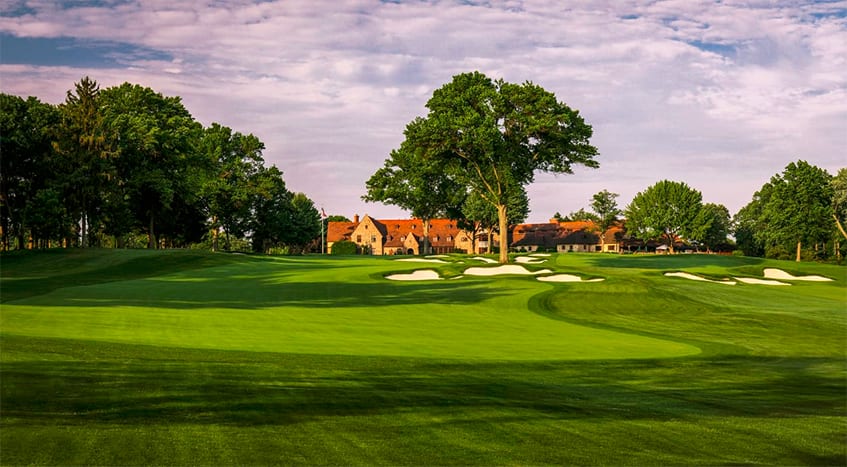
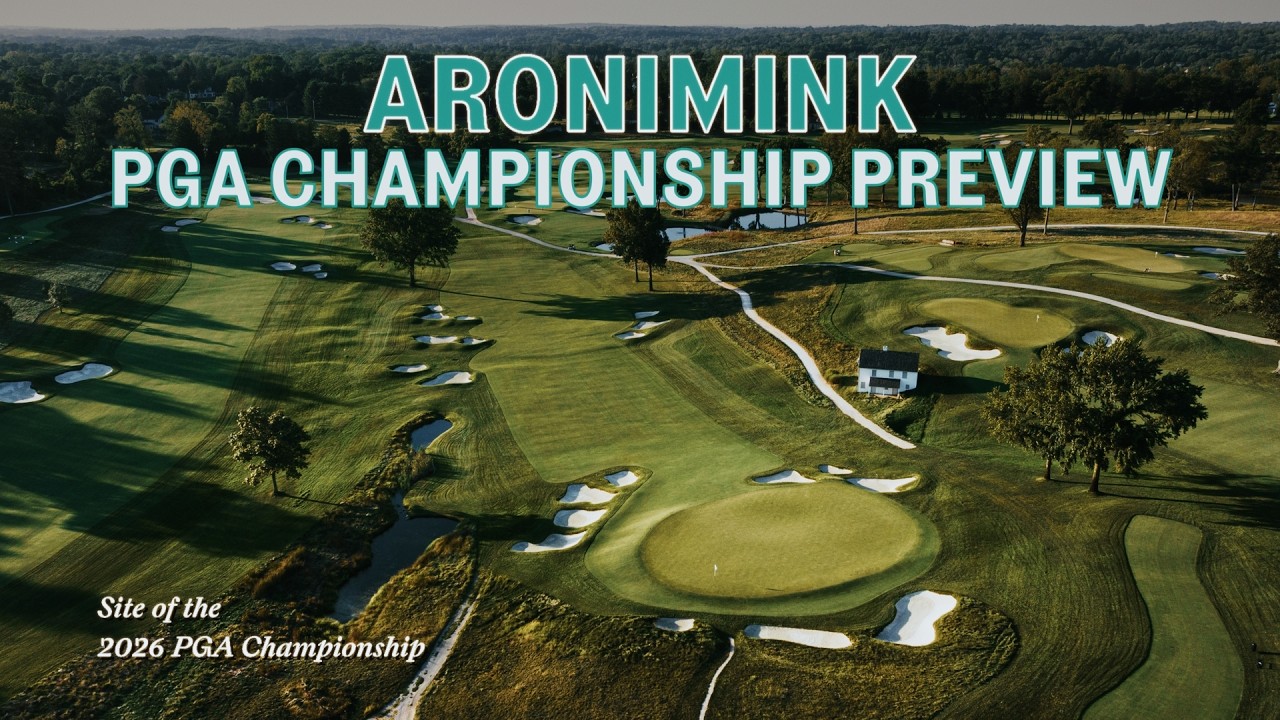
When the PGA Championship returns to Aronimink Golf Club later this month, the architecture itself will be one of the leading characters. In a Fried Egg Golf walkthrough released this week, the team behind the recent restoration set out exactly why a Donald Ross course on the western side of Philadelphia should make for a compelling major venue, and why firmness will decide the leaderboard.
The context matters. By the time Ross arrived at the property, William Flynn already had Rolling Green, Philadelphia Country Club and Huntington Valley nearby, with Merion and Pine Valley a short drive away. 'And so here was a chance to kind of show what he could do,' the restoration team explained, framing Aronimink as Ross's calling card in a town stuffed with great golf.
What he was given to work with was a bigger, broader landscape than most Philly courses, but with the same valley-and-ridge bones. The routing flips and turns through them. 'If you were to just sort of look down on top of it from an aerial perspective, you see a lot of holes running in parallel, but that's not how you play the golf course,' the architects said. 'There is constant change of direction.'
That unique topography is best understood as a bowl. 'You have holes that play along kind of the ridge of the bowl and those holes are mostly flat and they have very aggressive bunkering and really unique contouring on the greens,' the team explained. 'Then you have holes that play down into the bowl. And a good example of that is the eighth.' The signature stretch, though, is along the angled walls. 'The best holes at Aronomic are the ones that play along like kind of the edges of the bowl. What you're fighting there is really the topography and the camber of fairways.'
The greens themselves should be the headline. They are unmistakably Ross, full of internal tilt because of the property, but the unifying feature is what the restoration team calls 'pronounced spines'. 'You'll see these spines cutting on diagonals in different angles in the greens,' they noted, pointing to the par-three fifth as the most extreme example. 'You've got two spines that cut diagonally from the back of the green through the centre of the green. And they make four really distinct areas on the green.'
The practical effect is that lag putting becomes a premium. 'It's hard to guarantee a two-putt across this. It becomes just a real test, a nervy test of speed where you're just barely trying to get this over that spine so that it can kind of release out.'

The second visual story is the bunker scheme. Ross often built one large hazard per landing area; at Aronimink he didn't. 'When we started, there were 74 bunkers. We got up to around, you know, added 100, but the square footage didn't change dramatically.' The restoration leaned into the configurations Ross actually built rather than what was on his original plan. 'There have been a lot of conversations about his plan said one thing, he created something different.'
The payoff is playability that isn't just visual. 'You're in a smaller bunker, you're closer to the face, you've got a maybe a sometimes a compromised stance, you might have to stand outside the bunker, ball might be closer to the lip, either side-boards or face. So I think there are opportunities for the bunkers to play more difficult as a series of three as opposed to one larger bunker.'
Two holes look likely to drive Sunday narratives. Aronimink's short par-four 13th has been given a forward tee that should make it drivable for most of the field, with an out-of-bounds line cutting in sharply on the left side near the green. 'Players are either going to lay back behind the three sets of bunkers in the middle of the fairway or send it up here and go for the green and challenge this out of bounds line.' The green has a big channel through the centre, creating distinct pin tiers and 'a lot of day-to-day variety'.
The blind par-four seventh, meanwhile, asks something modern tour players almost never face. 'It's up and over a ridge. You can, you know, the hole's defined, like you can kind of understand where the perimeter of the holes are, but I think modern tour players, they don't see a lot of that. Certainly not week in and week out. And just trusting your line and hitting it.'
Which brings the conversation back to firmness. 'The magic in that golf course comes from firm conditions because then everything that Ross thought about, everything that he created is in play,' the architects concluded. 'Length doesn't matter to those guys. So it's ultimately let's give them a good test. Let's have it be firm and hey, the wind blows a little bit, then I like our chances there to have a really not only identify a great champion, but have, you know, the scoring be very reasonable for a major championship.'
If Aronimink stays dry between now and the first tee shot on Thursday, the spines and the angles will do exactly what Ross hoped.