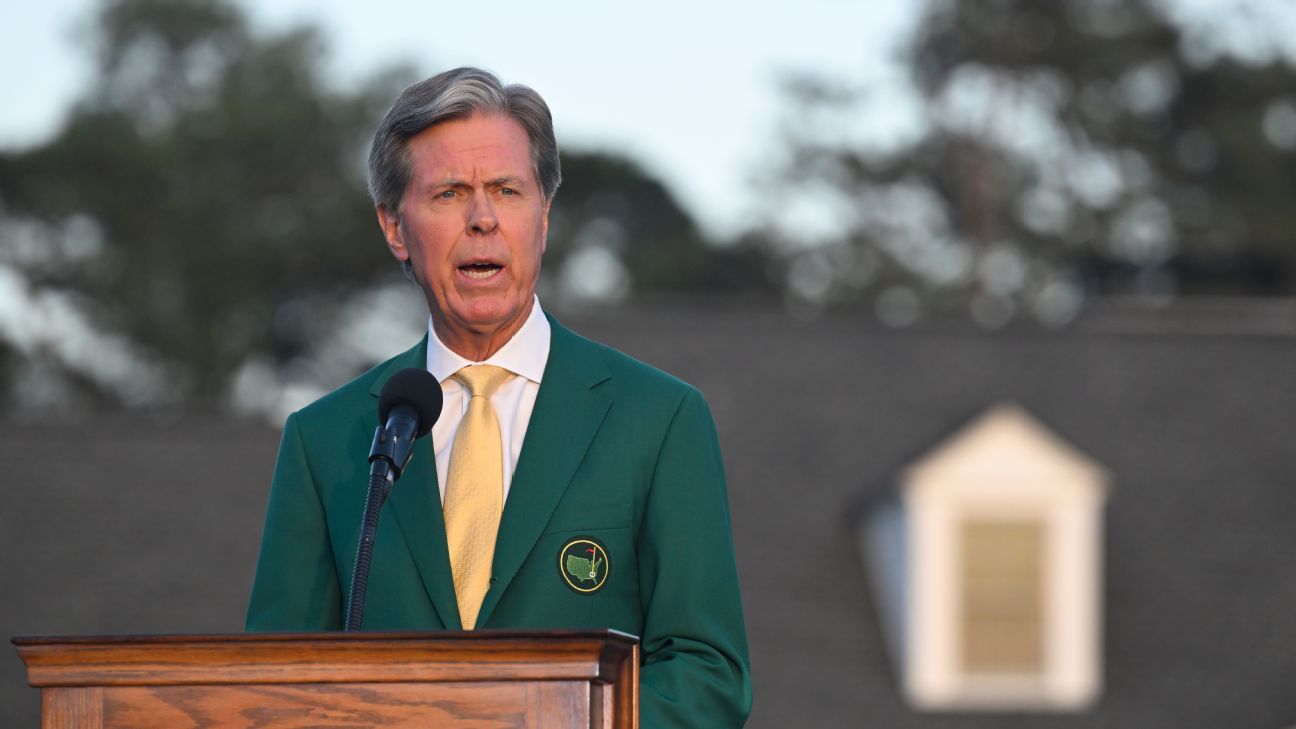
Augusta National Golf Club chairman Fred Ridley delivered a forceful endorsement of proposed distance regulations during his pre-Masters news conference, declaring the governing bodies' efforts to curb elite driving distances as crucial for preserving golf's essence.
"My feeling on this subject is [that] failure's not an option," Ridley said during Wednesday's media session. "I think we need to continue to work together to come to some agreement. Tough issues like this require compromise, and I think there has been some compromise to date."
The comments come as the golf world continues to debate the United States Golf Association's proposed Overall Distance Standard, which would reduce elite driving distances by 15 yards. Originally scheduled for implementation in 2028 for elite players and 2030 for all golfers, the USGA announced in March it might delay the rollout until 2030 across the board.
Ridley's stance reflects growing concerns about how modern equipment and athletic advances are fundamentally changing golf's strategic elements. He pointed to a striking example from this week's Masters practice rounds involving amateur Jackson Herrington, the 2025 U.S. Amateur runner-up making his Masters debut.

"About a 325-yard carry, and one was into the wind," Ridley said, describing how Herrington drove balls over the fairway bunkers on the first and fifth holes during practice.
The revelation underscores the challenge facing traditional golf courses, including Augusta National itself. The iconic venue has already made significant modifications to combat increased distances. The opening hole saw its tees pushed back 20 to 25 yards in 2002, followed by another 15 to 20 yards four years later. The fifth hole received similar treatment, lengthened to 445 yards in 2003 before another 40-yard extension in 2019.
"I want to reemphasize that support and affirm our position as the USGA and R&A represent their collective obligation as custodians of the game," Ridley said. "I also want to be clear that our position is grounded on much more than protecting the Augusta National golf course. We will continue to make modifications as are necessary to react to driving distances that in some cases exceed 350 yards."
"I've said that we can make changes, but there's not much we can do to make [additional] changes -- unless we tear down the Eisenhower Cabin, and we're not going to do that," Ridley said, referencing the cabin built for President Dwight D. Eisenhower and his wife in 1953.
The chairman emphasized that Augusta National's situation reflects a broader challenge across golf. Many courses lack the space or resources for continued lengthening to keep pace with modern distance gains.

"Unfortunately, many courses, including some iconic venues, do not have that option," Ridley said about making course changes. "Until recent years, golf has been a game of imagination, creativity, and variety. The game has become much more one-dimensional."
"We'll make changes when we can, but I think it's time to really address this issue. It's been talked about for a long time. There's certainly commercial interests that are at play here, and we all know what those are."
Addressing concerns about how equipment changes might affect recreational golfers, Ridley argued the impact would be minimal for most players while preserving golf's strategic integrity at the highest levels.
"Regulation of the golf ball is not an attempt to turn back time or stifle progress," he said. "It is an effort to preserve the essence of what makes golf the great game that it is."
The USGA and R&A are currently seeking additional input on implementation timing, with the feedback period ending April 16. The governing bodies are considering whether to implement changes for all golfers simultaneously rather than the originally proposed staggered approach.
Ridley also used the platform to address Tiger Woods' recent decision to step away from competitive golf and PGA Tour duties to focus on his health following his March 27 DUI arrest in Florida.
"I would like to add that we fully support Tiger's recent decision to focus on his health and well-being," Ridley said. "Our commitment to the TGR Foundation and to Tiger personally has not wavered. We wish him the very best."
The distance debate will likely intensify as the Masters unfolds this week, with players demonstrating the very power that has prompted calls for equipment regulation. Ridley's strong stance signals Augusta National's commitment to supporting changes that could fundamentally reshape professional golf.