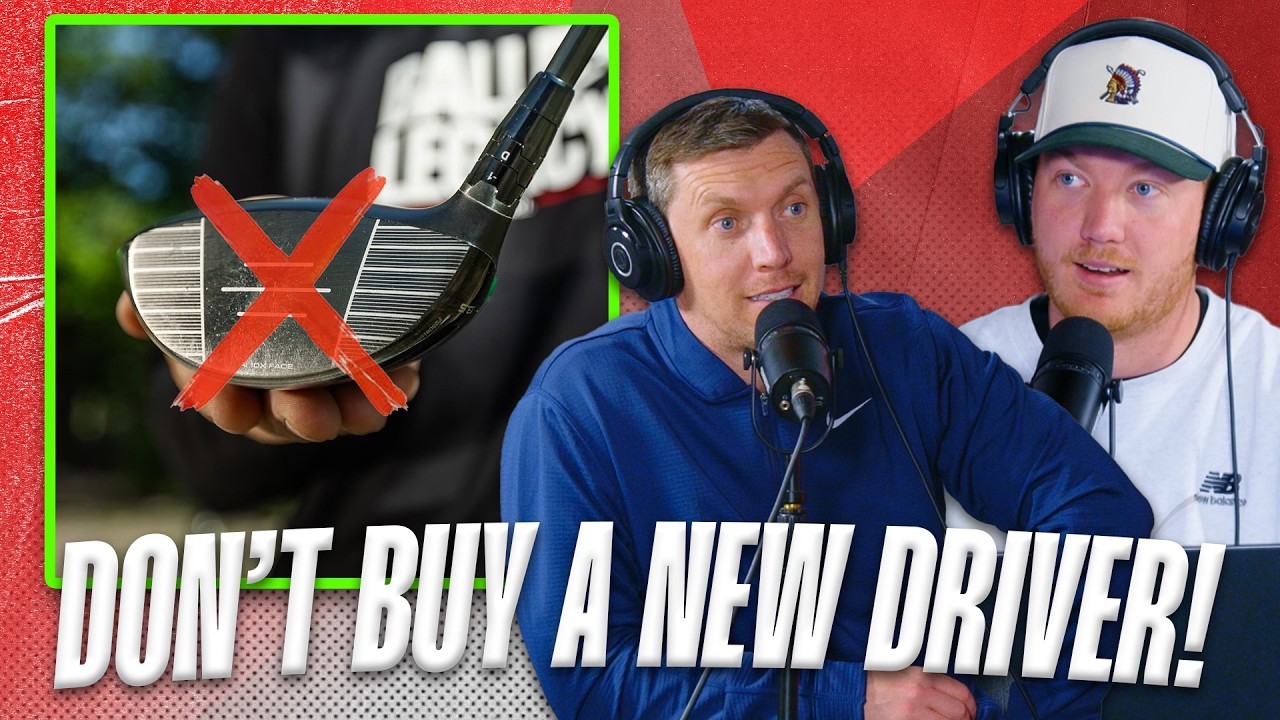
Rick Shiels has spent 15 years building a YouTube driver-launch industry: every new TaylorMade, Callaway, Ping and Titleist release tested, ranked, hyped. So when Shiels devoted the lead segment of his Friday Pro Shop podcast this week to a single question — has any of that distance actually shown up in real golfers' rounds? — the answer he delivered was the most uncomfortable one his audience could hear.
It hasn't.
The data Shiels and co-host Ben Sabo worked through came from the latest annual Arccos driving distance report, the largest dataset of its kind in golf. The 2025 edition, which Arccos has now published in some form every year since 2018, was built on more than five million rounds and almost 10 million driver tee shots logged through Arccos sensors and shot-tracking apps.

"Eight years, how much do you think the average golfer has gained in driver distance?" Shiels asked his cohost, who guessed nine yards. The producer behind the camera went 10. Both were thinking conservatively after watching pro golfers hit it visibly farther across the same period.
The actual number stopped them cold. "In 2018, the average golfer against all abilities and all ages, the average golfer was hitting it 224 yards on average. This year, 2025… 224.1. We've gained 0.1 of a yard," Shiels said. "Essentially golfers are not gaining distance. That's male golfers, I may add. Female golfers have actually lost four yards."
The implication for golf's billion-dollar driver-marketing complex is brutal. Eight years of "two yards longer than last year" launches, eight years of fitting carts and launch monitors and faster faces, and the average male golfer is gaining a tenth of a yard.
But the more useful insight from the Arccos report sits one layer down, in the gap between scratch and high-handicap golfers. The dataset shows the zero-to-4.9 handicapper averages 244 yards off the tee. The 30-plus handicapper averages 181. That 63-yard gap is one of the clearest single-statistic explanations of why scratch players shoot 70-something and 30-handicaps shoot 100-plus: every par four is effectively a different golf hole.

The data on accuracy is even more telling. Scratch-to-five handicaps hit the fairway 50 per cent of the time. Thirty-plus handicaps hit it 40 per cent — closer than most listeners expected. The difference, Shiels noted, is what happens when they miss.
"Scratch handicappers, 4.9 handicappers, they hit an average of 12 per cent wayward tee shots. But out of those wayward tee shots, 4.4 per cent will be in penalty areas, so out of bounds, water hazards, and 7.6 per cent will be a recovery shot — chip out sideways," he said. "But this is where the 30 handicapper gets stung. The 30-plus handicapper, 45 per cent are wayward. 12 per cent of that are penalty areas. And 33 per cent — a third of all their tee shots — are they need a recovery shot afterwards. They're in a bunker, they're in thick juicy horrible rough, kind of tree."
That single statistic is the crucial one, Shiels argued. The double-digit-handicapper's problem is not the driver they bought. It is that one third of their drives turn into a chip-out that has nothing to do with face technology.
For the 15-to-19.9 handicap audience that buys most new drivers, the same trend holds. Twenty-eight per cent of tee shots are wayward, 20 per cent require a recovery, and eight per cent end out of bounds or in a hazard. Even with a brand-new $700 driver, those numbers are largely unchanged year on year.
Shiels closed the segment with what he conceded was a financially inconvenient conclusion for his own genre of content. "The moral of this story is your bad shots, your really bad shots, are what is costing us as golfers," he said. "If you've got two guys, 18 and zero handicap, yes there's going to be a difference in distance, but so much of it comes from missing the fairway and missing it by a long, long way."
His takeaway for the listener tempted by a 2026 driver launch was unvarnished: priority one is getting the ball in play off the tee. A new driver alone, the eight years of Arccos data suggests, will not do it. Lessons, fitting, and short-game work will.
The Arccos report also notes one final wrinkle that runs against golf's marketing instincts. Across the dataset, skill — not age — is the strongest single predictor of distance. A fitter, technically better 60-year-old will routinely outdrive a 25-year-old higher-handicap player. The implication is the same as the rest of the report: technology alone is not pulling distance out of average golfers, and the brands selling that promise are running out of room to back it up with data.