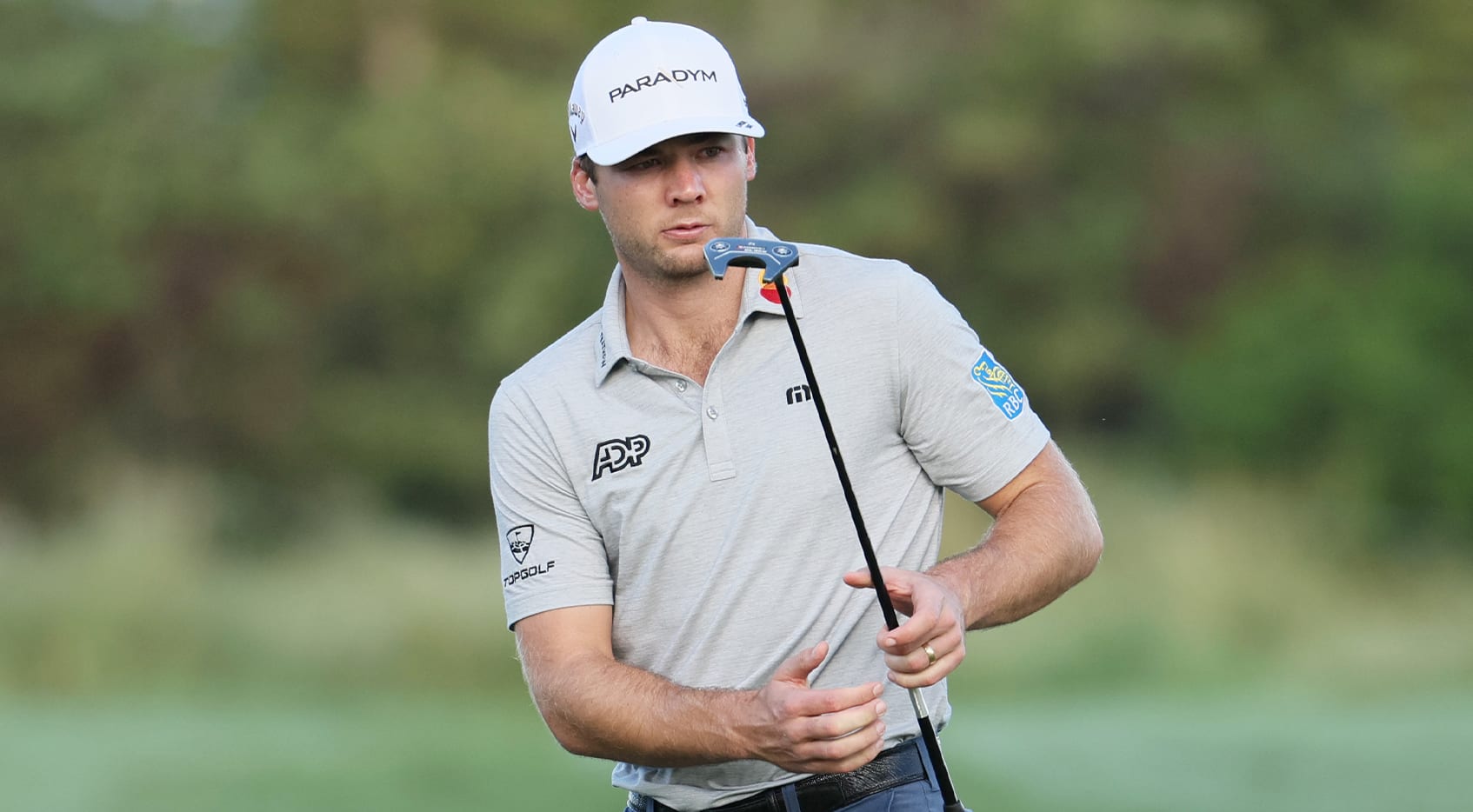
Sam Burns has been the best putter on the PGA Tour for two years running, and the 29-year-old American's secret, as it turns out, is that there isn't one. In a Callaway Golf Europe masterclass filmed earlier this season, Burns walked through the routine that has produced more strokes-gained-putting per round than anyone else in professional golf and pointed at simplicity as the through-line.
'I try to keep putting very simple,' Burns said. 'So it kind of fits that mould, I guess.'
The putter is the same one he has trusted for years. 'The number seven model, this particular model for the last three years, but this style of putter probably for the last seven years.' It is not face-balanced. 'It's got a little toe hang. Not a ton, but a little bit.'
The daily warm-up is built around one straight five-footer. 'Every day how I'll start, I'll find a five-footer that's pretty straight,' Burns said. 'Once I find where the straight putt is, I'll take a chalk line and pop a line on the green. And really what that does for me is that I work on my stroke on the line. I'll put a couple of tees down, you know, a foot kind of in front of where I'm putting, just a little bit wider than the golf ball, just to work on start direction. So it gives me immediate feedback on my stroke and start direction. I'll hit fifty to a hundred on that kind of every day.' Only after that does he start working his way around the hole.
For amateurs, the most common mistake on short putts isn't aim. It's pace. 'I would say if anything from what I usually see in amateurs is, especially on short putts, is they hit them way too hard,' Burns said. 'When you hit these short putts too hard, or really any putt too hard, it really makes the hole a lot smaller. You'll see a lot of times like they'll hit decent putts and they'll hit the right side of the hole and lip out. So what I try to work on is how big can I make the hole from this distance.' The drill he uses on a four-footer is to roll the ball at a speed that wouldn't reach the back of the cup if it missed.
That ladders directly into one of his more contrarian beliefs. The most common amateur instinct on a short breaking putt is to take the break out by hitting it firm. Burns thinks that is a mistake. 'It's the worst thing you could possibly do,' he said. 'If you have a four or five-footer and you hit it three and a half or four feet by and you miss it, well then you have the same putt again. And that putt only gets more difficult the more you have to do it.'
For lag putting, his trick is to break the distance into thirds. 'A lot of people get really intimidated by long putts. So what I try to do is I'll break it up into like three segments. So if I had a 40-footer, you know, I would take the first third, read that, the middle point, and then the last third of the putt. It just kind of helps my brain process that distance a little bit easier.' He still feels each segment with his feet, the standard AimPoint cue he has used for most of his PGA Tour career.

He does not use a line on his ball. 'I try to aim at something three or four inches in front of my ball,' Burns explained. 'I've always found it's easier to aim at something closer than something fifteen or twenty feet away.'
The quietest part of the conversation might also be the most useful for weekend players. Burns said the inner-monologue trap that ruins amateur putting begins with expectation. 'I think a lot of times it starts with your expectations,' he said. 'I've played with amateurs who, you know, just say, ten handicap, and they expect to make everything from ten feet. And it's like, if you look at the best players in the world, they don't make every putt from ten feet. So why should you expect to do that?'
His own definition of a successful putting day, as a result, doesn't even involve makes. 'If I look at success on the putting green, it's not how many putts I make. I think that's where a distorted view of success comes from and people get upset and frustrated with their putting when they don't feel like they're holing a lot of putts. If I feel like I'm reading them well, hitting my start lines, good speed, like that's success for me on the putting green.'
In other words, the world's best putter spends his time worrying about process, not outcome. 'There's so many things that can disrupt a golf ball on the green,' Burns said. 'Whether it hits a piece of grass or the wind blows. So I really try to focus on picking that spot, hitting a good putt, and then after that it's out of my control. I think that's the best way for me to kind of work through putting and being able to accept whatever happens.'