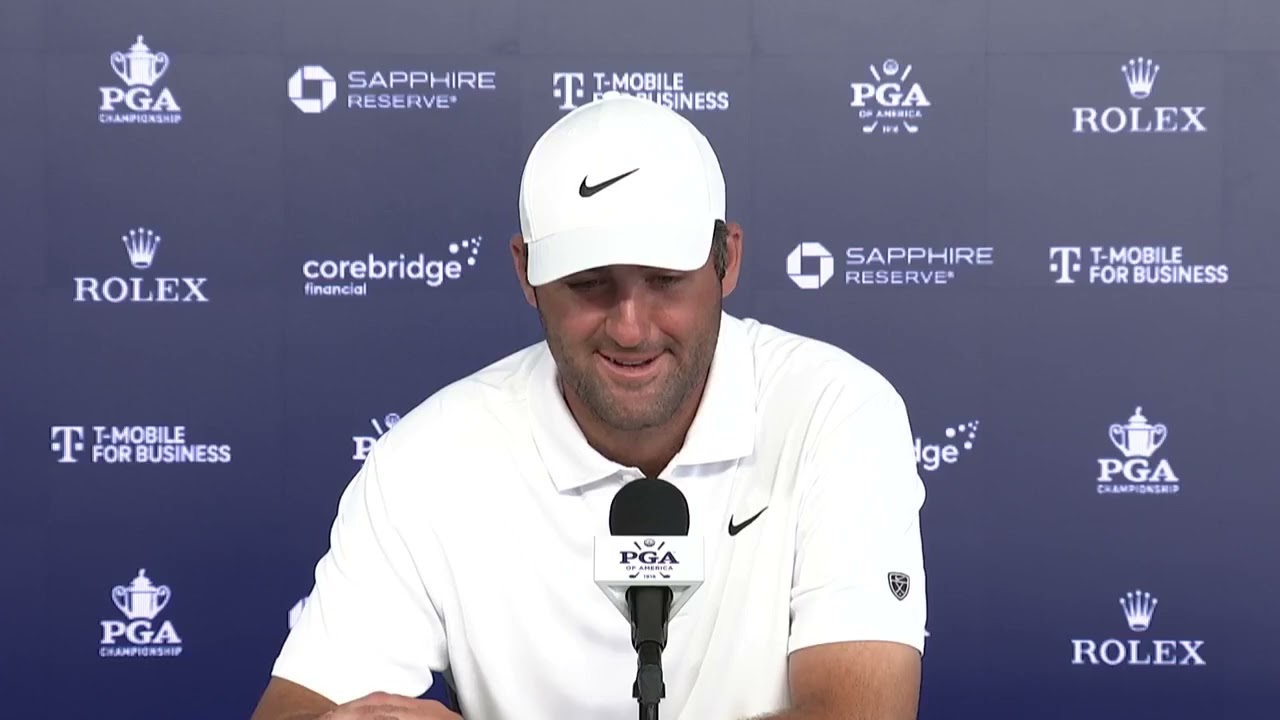
Scottie Scheffler walked out of the scoring area at Aronimink on Saturday afternoon with the calm, slightly weary expression of a player who had spent four hours doing almost everything right and not seeing the leaderboard reward him for it. The world No. 1 had played a third round that, by his own assessment, was a strong ball-striking effort undone by a course doing things that no amount of preparation could fully neutralise.
Asked what had not worked for him on Saturday, Scheffler returned again and again to the conditions and the course.
"I mean, I think the golf course is just challenging," Scheffler said. "There was, I mean, extremely high winds. There's a lot of pitch on the greens, so there's not a ton of opportunities for birdie. And I felt like I did a good job today kind of hanging in there. Hit some good shots, hit a lot of good putts that were kind of right around the edge. It's kind of like a little bit of a dice roll at times when you have so much slope and so much wind."

The "dice roll" framing was unusual for a player whose entire competitive identity is built on process repetition and tactical patience. Scheffler does not usually reach for the language of chance. That he did on Saturday was a reflection of how Aronimink's combination of fescue, fast slopes and Pennsylvania wind had pulled even the most precise ball-strikers into a margin business.
The leaderboard he was looking at when he came in told its own story. By Saturday evening at Aronimink, 21 players sat inside three shots of the lead — until Alex Smalley pulled his lead to five — and the major championship had effectively redistributed itself across half the field. Scheffler was asked what that did to his mental approach for Sunday.
"Firstly, no, I've never seen anything like this," Scheffler answered. "When we were out there, it was a just a nature of a lot of different things. But yeah, I've never seen a leaderboard like this this bunched up. But going into tomorrow, it's quite literally anybody's tournament. There's a lot of guys that have a chance. And going into tomorrow, just somebody is going to have a great round. I'm going to go out there and make sure I do my best to give myself the best shot at being the one who has a great round."
It was a notable admission from a player who has set the bar for the modern game's metronomic excellence. Scheffler's record on weekends of major championships is one of the most reliable resources in the sport. Saturday's third round was, by his own account, an exercise in survival rather than separation. Asked specifically whether the frustration of putts not falling would linger, he was clear.

"I mean, it definitely doesn't linger," Scheffler said. "I'll go out and practice a little bit. I get my mind ready to go tomorrow. I won't think much about this round past today. I hit a lot of good shots, felt like I hit some good putts. It's just I, it's a challenging golf course."
By Sunday evening, the prediction of an open Aronimink Sunday had been borne out. Aaron Rai outlasted the entire crowd by playing a strategic, positional game that ran against the bombers' template the course had been expected to demand. Scheffler did not have his great round on Sunday, finishing well off the lead in a tournament that, on his own framing of Saturday, had become a different animal: less a major to be solved by precision, more a Saturday of slopes, gusts and putts catching the edge — a dice roll for the entire field, including the world No. 1.