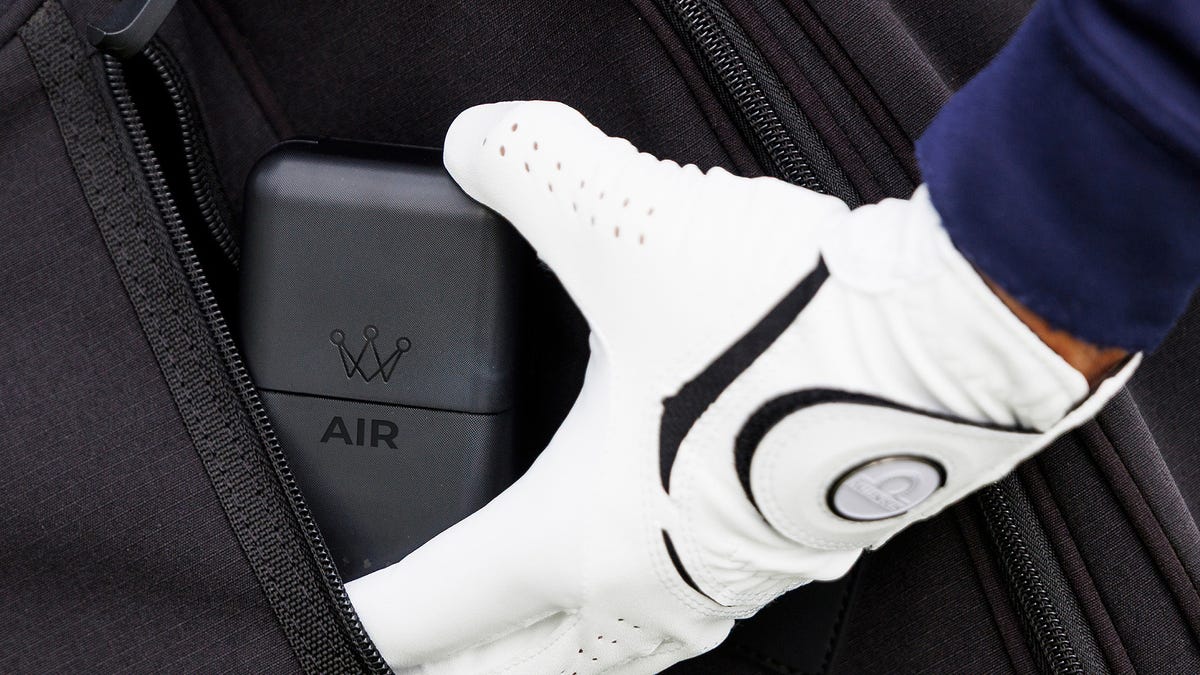
Golf technology has long promised to improve players' games, but often at the cost of convenience. The new Arccos Air system represents a significant shift in how golf tracking works, eliminating sensors while maintaining the data golfers need to improve their performance.
For over a decade, Arccos has pursued what seems like a contradictory goal: creating technology that helps golfers by staying out of their way. The company's latest product, Arccos Air, appears to be the culmination of that vision.
Priced at $349 and including a year's subscription to Game Tracking valued at $199.99, Arccos Air operates on a refreshingly simple premise. Players simply activate the app and the matchbook-sized device at the first tee, then forget about technology for the rest of their round.

The system eliminates the need for individual club sensors entirely. Instead, Arccos Air relies on built-in gyroscopes, accelerometers, and a microphone to analyze and recognize golf shots automatically. GPS technology pinpoints exact locations on the course, while sophisticated algorithms connect shots together to build a complete picture of each round.
This sensorless approach addresses several pain points that have plagued golf tracking systems. Traditional sensor-based systems can suffer from sensors falling off clubs, battery failures, false readings from clubs clanking together, and time-consuming post-round editing. While none of these issues are insurmountable, they create friction that can discourage consistent use.
The technology behind Arccos Air draws on an massive database of golf information. The system leverages machine learning trained on 1.5 billion golf shots and over 25 million tracked rounds to recognize swings, impacts, and outcomes without requiring sensors on every club. Essentially, years of data collection from Arccos users worldwide has made this sensorless system possible.


However, the company acknowledges certain tradeoffs with the new approach. Without sensors, Arccos Air cannot automatically identify which specific club was used for each shot. For golfers who rely heavily on detailed club-by-club performance analysis, this represents a significant limitation.
Arccos counters this concern by emphasizing that much of their strategic analysis focuses on distance ranges and shot patterns rather than specific club labels. The company argues that understanding where the ball went and how far it traveled often matters more than whether the shot was labeled as a 7-iron versus a 6-iron.
For golfers who still want that granular level of detail, the traditional sensor system remains available. Arccos Air doesn't replace the existing technology but rather provides an alternative entry point with lower barriers to consistent use.


The launch of Arccos Air coincides with several other innovations from the company. Recent additions include the Smart Laser rangefinder, which emphasizes how shots play rather than simple point-to-point distances, and an AI Strategy feature that uses course topography and extensive data sets to recommend target areas. Green Maps now provide insights into how balls should behave on putting surfaces.
These complementary technologies suggest Arccos is betting that golfers are ready for more sophisticated, AI-driven insights that work seamlessly in the background. Rather than requiring golfers to adapt their routines to accommodate technology, the company appears focused on making technology adapt to how golfers naturally play.
The success of Arccos Air will likely depend on whether the convenience of sensorless tracking outweighs the loss of specific club data for most recreational golfers. As golf technology continues evolving, the system represents an important test of whether simpler, more automated solutions can deliver the insights players need to improve their games.