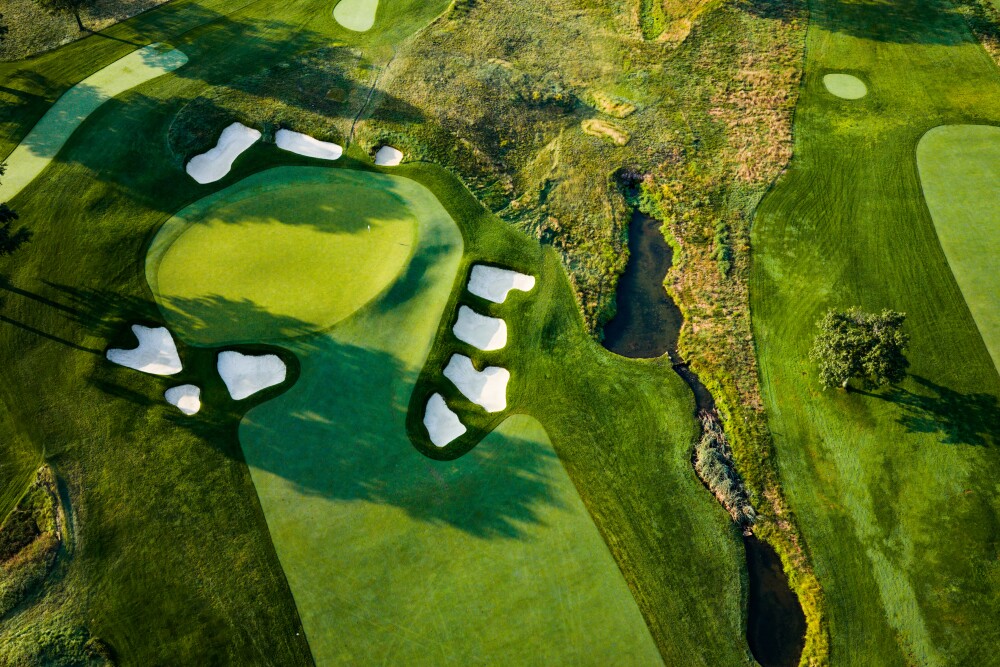
When the 2026 PGA Championship tees off at Aronimink Golf Club next week, it will be the first time the season's second major has visited the suburban Philadelphia layout since Gary Player won there in 1962. Sixty-four years on, the test the world's best players will face is not the course Player conquered. It is, by design, an even older one.
In 2017, architects Gil Hanse and Jim Wagner were tasked with peeling back decades of well-meaning tinkering and returning Aronimink to the original 1928 Donald Ross design. The most visible result is the bunkering. The course now plays with roughly 180 traps — including 20 on the 11th hole alone — after Hanse and Wagner restored 75 sand hazards and split many of Ross's larger bunker complexes into the smaller, more strategic shapes Ross had originally drawn.
"Whenever you're entrusted with a great old golf course like Aronimink, and then to have it be in your own hometown, it's pretty exciting," Hanse said.

"The restoration of that bunker style and those configurations is definitely the most dramatic part of what we did," Hanse added.
For Hanse, the test of a major will not come down to bombing the ball off the tee. Aronimink stretches to 7,394 yards but plays as a par-70, with only two par-5s and four par-3s — three of which exceed 210 yards. The architecture pushes the entire field's strategic decision-making into the second shot and the area around the greens.
"I think it's going to be somebody's creativity around the greens, the ability to get up and down, that will be the critical part," Hanse said.
The greens themselves are an authentic Ross artefact. Director of Golf Jeff Kiddie noted that the putting surfaces in play this week are essentially the same complexes Aronimink members have been reading since the late 1920s, ranging from a 5,600-square-foot target on the par-3 fourth to an 11,000-square-foot expanse on the 15th.
"It's a classic northeast Donald Ross course. We have the authentic Donald Ross greens that were built almost a century ago, in 1928," Kiddie said.
"If you look at players who have won here — Gary Player, Justin Rose and Keegan Bradley — they always seem to be a well-rounded player," Kiddie said.
For Kiddie, the championship is also a once-in-a-career moment.
"It's almost a once-in-a-lifetime opportunity. There hasn't been a PGA Championship in Philadelphia since 1962. This is very personal for me," he said.
The PGA of America's chief championships officer, Kerry Haigh, framed the test similarly, suggesting the venue's premium will not be on length but on the demands placed on putting and short-game touch.
"It's a wonderful course. It's not overly long for today's players — 7,400 yards, par 70. The greens will be the challenge," Haigh said.
The strategic profile favours precision iron play. With most approaches coming from 150 yards or more, often from canted lies created by Aronimink's natural topography, the course rewards positional accuracy over raw distance. Pre-tournament analysts have flagged elite mid- and long-iron players, and lag putters comfortable on Augusta-fast surfaces, as the names worth following.
For a generation of touring professionals raised on power-driven majors, Aronimink's restored 1928 chess problem may demand an unfamiliar gear. Six days from the opening tee shot, the architecture is set. Now the field has to find a way to play it.