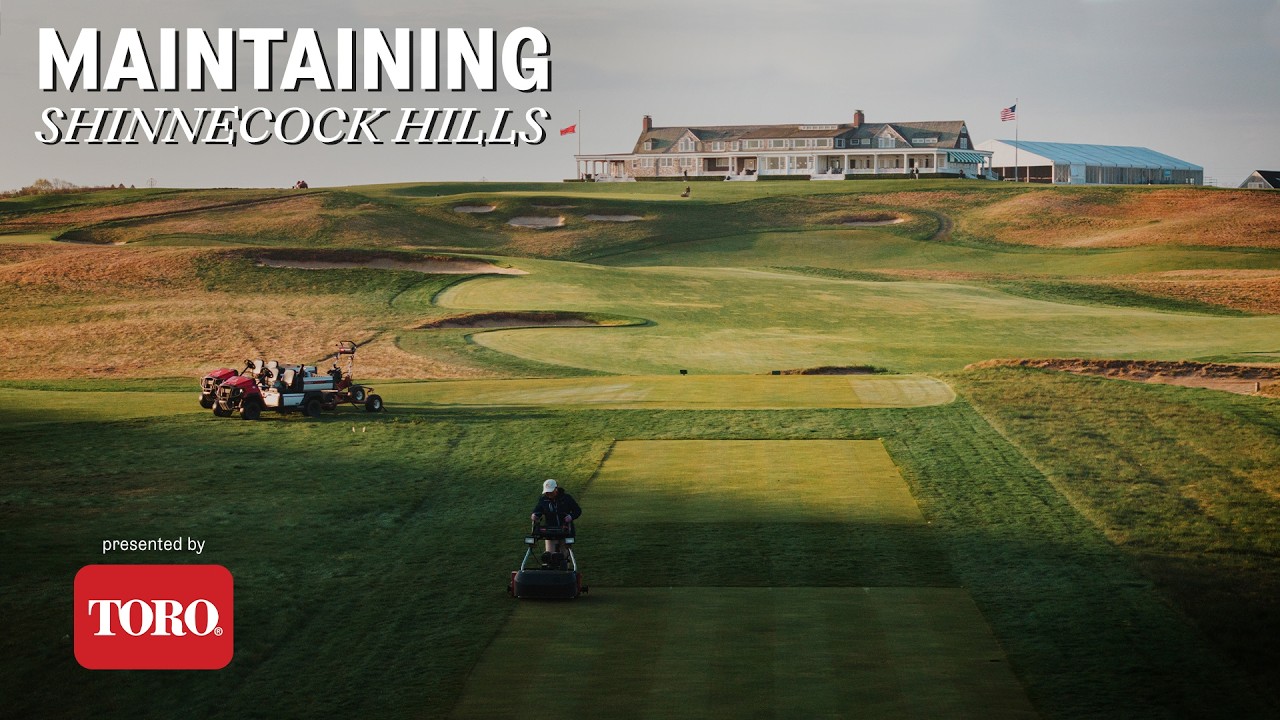
Three weeks out from the 2026 US Open, the championship golf course is not the one the world will see in June. It is the one Jon Jennings sees at six in the morning, when the dew is still reforming on the greens, the south wind is starting to lift and his 40-person team is gathered for a five-minute aerobics routine before another day of trying to keep poa annua alive in the open Atlantic air.
Jennings, the golf course superintendent at Shinnecock Hills Golf Club in Southampton, New York, opened the gates this week to The Fried Egg's All Grass Is Local series for a depth piece on the daily reality of preparing one of golf's most famous tests for its fourth US Open this century. The picture he painted is less about magic and more about siege warfare against weather, time and sand.
"So, if you think about the southern fork of Long Island, we are 90 miles out in the ocean," Jennings explained. "We've got the Atlantic Ocean to our south, the Great Peconic Bay and Long Island Sound to the north. So, it's constant wind from any side. That's one of the biggest challenges that we have here, just monitoring the weather and trying to figure out how to manage the turf grass so we don't have anything detrimental happen to it during the day."

The course is essentially glacial outwash, a 70-foot rise and fall of weathered sand draped with a hodgepodge of turf species. Tees are mostly bent grass, fairways are a mixture of rye, poa and bent, and the greens are predominantly poa annua, the weaker and more demanding grass that Jennings's team monitors most closely.
"It requires a little more water," Jennings said of poa. "I'll just say for lack of words, a little more needy. It requires more nurturing throughout the day."
The greens are 1931 Flynn originals modified through decades of top-dressing. Seven of them have internal drainage; the fifth, sitting on a pocket of clay rare for the property, sometimes asks more questions than the rest. The fastest-drying greens are the ones most exposed to the prevailing southerly. "We'll see a differential in numeric value and moisture five to eight points based on the wind," Jennings said. Anything with a false front catching wind from the south will desiccate on the front and stay fine on the back, a quirk his crew has to manage by hand.
The bunkers, more than the greens, are where the wind exposes itself most cruelly. "At Shinnecock Hills, that's one of the main things that we deal with on a day-to-day basis is wind," he said. "We like to call it it's like the war against the wind every day. I know that when you think of wind, you think of the turf first and the desiccation it can do to the leaf blade, but one of the things we really see out here is the constant movement of sand. Sand in the bunkers is moving all the time and we rake every day. So, we're in them every day. People are walking in and out of them every day and the wind's ripping every day."

At the par-three second, the front-right bunker that Jennings's crew test most frequently is shaped like a bowl. The first sign that it needs to be rescraped is the appearance of stair-stepping in the face where sand should be smooth. The other is a footprint sinking into the face when his crew walk it.
"And I mean I love your website but we can't have any fried eggs out here. We just can't have them," Jennings told the Fried Egg crew. "If balls are plugging that's when the people get unhappy whether it's players competing for the US Open or our members on a day-to-day basis."
The management story Jennings tells is also a story about people. Forty staff. Seven assistants, all turf grass graduates. One crew member who started at Shinnecock in 1984 and will work his fifth US Open. A five-minute aerobics routine each morning that began as a personal experiment and is now part of the culture. "We've probably watched it 2,000 times, but if you asked us do it without watching the video, I don't think we could do it all in sequence," he said. "It's kind of like a physical cup of coffee."
Most of the heavy lifting, he insisted, is already done. Aerification, top-dressing, over-seeding, fertiliser programmes, native rough rebuilds, blind-shot landing-zone netting on the tenth and a half-dozen other holes. The rest is weather and patience.

"It's no different than getting ready to sell a house," Jennings said. "Just prepping that and all the little detail work that you need to make it work right."
The field will arrive in mid-June at a course that has now hosted US Opens in three different centuries. By then the superintendent expects to have spent another month at three to five hours a morning walking it himself ahead of the first group. "What makes Shinnecock Hills special to me," Jennings said, "is just a feeling you get every time you come up here."