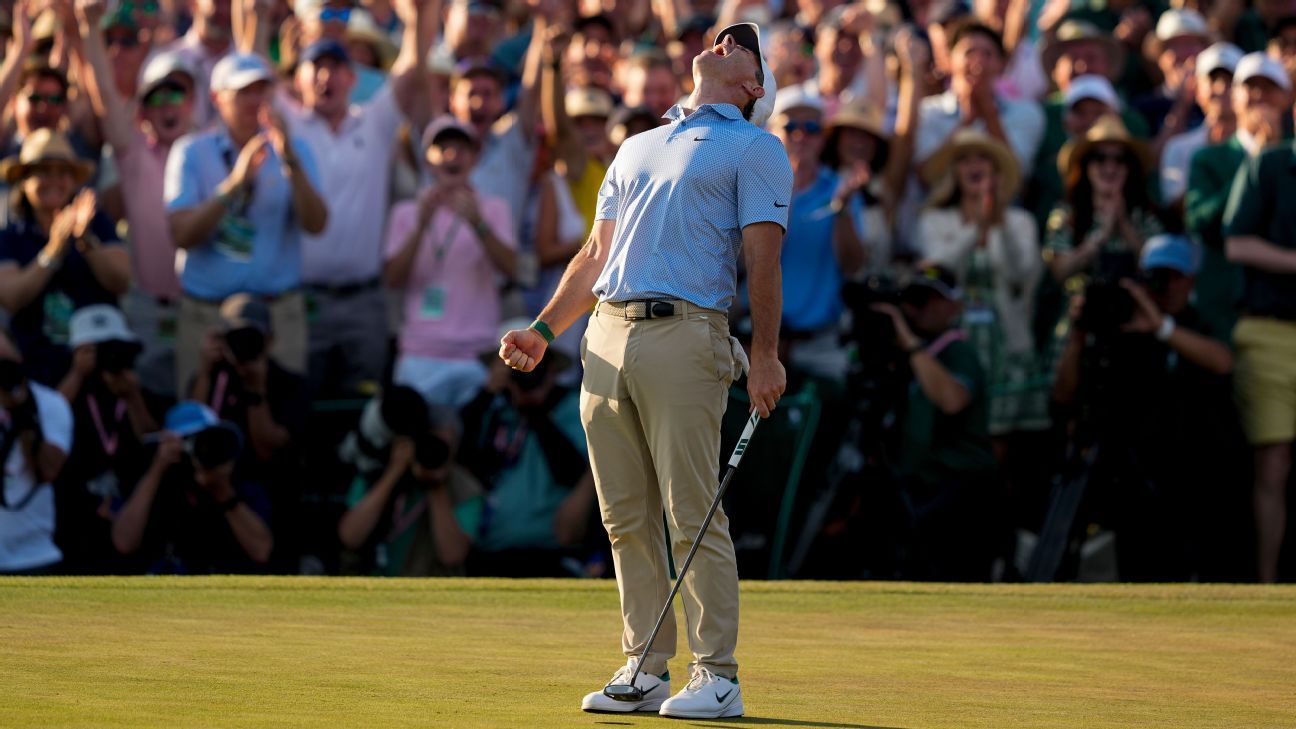
AUGUSTA, Ga. -- Rory McIlroy's expression said it all as he approached his ball, situated dangerously off the 18th fairway at Augusta National. With the weight of a six-shot lead now a memory, he let out a deep sigh. Winning at the Masters was never going to be easy, not even for someone who had already donned the iconic green jacket.
"I thought it was so difficult to win last year because of trying to win the Masters and the grand slam," McIlroy said, reflecting on his earlier victory. "And then this year, I realized it's just really difficult to win the Masters. I tried to convince myself it was both."
Despite holding a two-shot lead heading into the final moments, McIlroy faced a challenging path. The die was cast for a simple celebration: all he needed to do was find the fairway, hit the green, and stroll to victory. Instead, he took an arduous walk to create a clear path for his final shot, a reminder that winning rarely comes easy.
"I don't make it easy," McIlroy remarked. "I used to make it easy back in my early 20s when I was winning these things by eight shots. It's just hard. It's hard to win golf tournaments."
Over the last year, McIlroy has grappled with the pressures of competitive golf. He admitted to feeling a lack of motivation at times, recognizing that the pursuit of a grand slam was more fleeting than fulfilling. However, as the anniversary of his previous Masters win approached, his focus sharpened. In the weeks leading up to the tournament, Augusta became his training ground.

"I joked last week and going into this week that this place feels like my home course," McIlroy shared. "I haven't played anywhere else in the last two or three weeks, really."
His commitment included frequent visits after dropping his daughter, Poppy, at school. By immersing himself in Augusta's challenges, he rekindled his passion for the course, even simulating tournament conditions to hone his skills. He often practiced with just a single ball, exploring areas of the course he had previously overlooked. Rumors swirled that he had nearly set a course record with a stunning round of 62 during practice.
"My scrambling and my short game and my putting," he stated. "That's what won me the tournament this week."
However, past experience had taught him that leads can vanish in an instant. On Saturday, McIlroy quickly lost his grip on his six-shot lead, forcing him to fight back to stay competitive. Sunday was no less dramatic; he dropped behind early but fought back to regain his footing. A double-bogey on the fourth hole saw him slip two shots behind the leaders.

The turbulence of the tournament culminated at Amen Corner, where McIlroy stood on the tee of the 12th hole, recalling advice from legend Tom Watson regarding the deceptive winds at Rae's Creek. This moment served as a guiding principle as he made his decision, following Watson's wisdom to gauge the wind before his shot.
"He always waited until he felt where the wind should be and then just hit it," McIlroy noted. "Just hit it as soon as you can."
As the final holes unfolded, McIlroy displayed not just technical skill but the experience and mental toughness that define a champion. His trajectory throughout the tournament emphasized the cyclical nature of competitive golf; victory is both an art and a struggle. With this remarkable back-to-back triumph at Augusta, he reaffirmed his position among the greats, proving that within the sport, nothing ever truly comes easy.
Looking ahead, McIlroy's performance at the Masters serves as a statement as he continues to navigate the competitive landscape of professional golf. As he gears up for future events, fans will be eager to see if he can maintain this level of excellence.