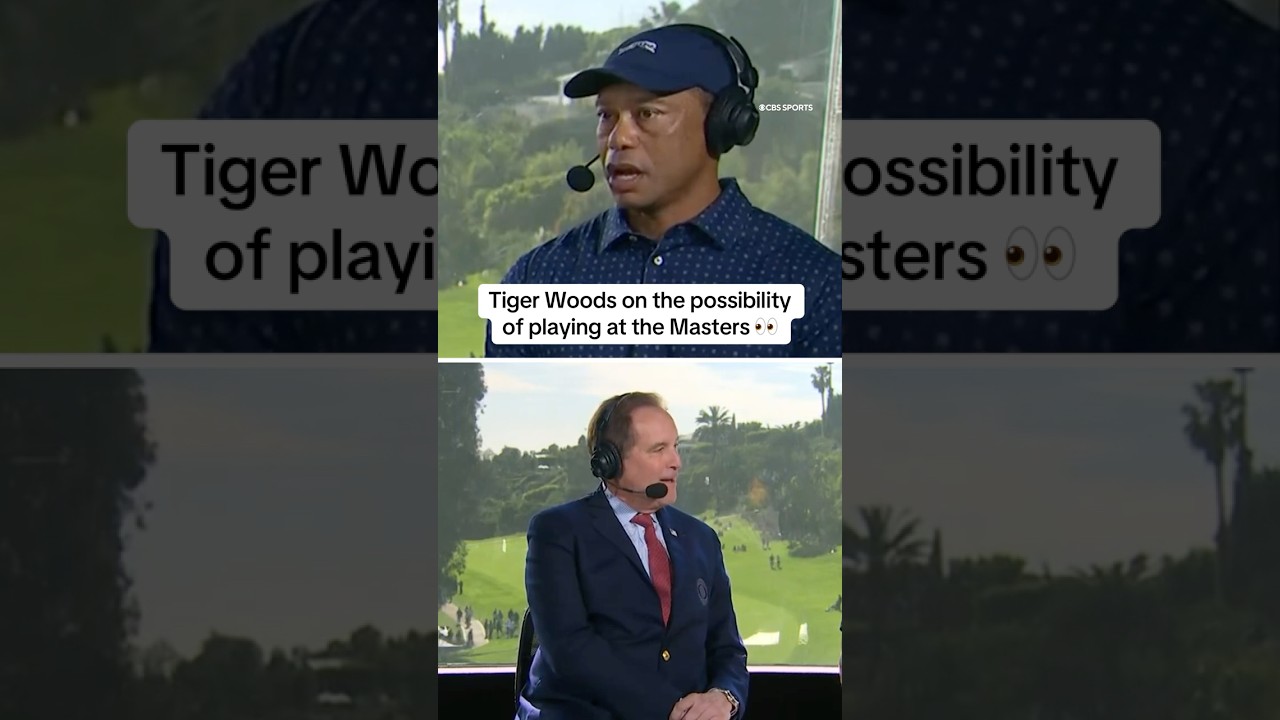
Two months before the 2026 Masters, Tiger Woods gave Golf on CBS an interview that, in hindsight, deserves a second reading. The five-time champion's comments on February 21 offered a quietly revealing look at how he is navigating the competitive end of his career — and how, even when playing the tournament is uncertain, his connection to Augusta National remains non-negotiable.
Asked directly whether he could be out on the golf course at Augusta, Woods did not commit. "There is," he answered, confirming a possibility existed without overstating it — a guarded response typical of a player who has learned, perhaps more than most, that health and golf calendars rarely line up neatly.
The more telling exchange came moments later, when the conversation turned to the broader week at Augusta. Whether or not his body was ready for four competitive rounds, Woods made clear his Masters presence was not in doubt.
"I know I'll be there," Woods told Golf on CBS. "We're going to open up the patch, and Trev and I are going to be part of a great dinner."
The reference to "the patch" is Masters shorthand for the ceremonial activities that mark the tournament week. Past champions typically take part in rituals that range from practice-round pairings to the Champions Dinner on Tuesday evening, where defending champions host the field of green jacket holders. For Woods, whose role at Augusta is now as much as an elder statesman as a competitor, those traditions carry obvious weight.
"Trev" refers to Trevor Immelman, the 2008 Masters champion and a close friend of Woods' who has remained a regular presence around Augusta as both a past champion and a broadcaster. Their planned dinner was framed as a personal rather than public commitment — the kind of detail Woods would not typically volunteer unless he wanted to signal that his engagement with the tournament is not contingent on his playing status.
For a player whose playing availability has been one of the defining uncertainties of the last half-decade of Masters weeks, the measured tone of the February interview is instructive. Woods did not hype the possibility of playing. He did not shut it down either. He simply acknowledged that a possibility existed and moved the conversation to the ceremonial dimensions of the week — the parts of the Masters that are not up for negotiation.

The interview has gained resurfaced attention in the weeks following the tournament, particularly as Woods' wider storyline has continued to dominate golf's off-course conversation. Revisited now, the February remarks land differently than they did at the time. Woods, then as now, was drawing a clear line between the competitive side of his Masters relationship and the traditional side. He was signalling, in his characteristically understated way, that even if the rounds did not materialise, his place at Augusta was secure.
That distinction — between playing and belonging — is increasingly where Woods' Masters story sits. At 50, he is no longer a presumptive contender. But he remains, by his own telling and by the tournament's own preference, a fixture. The patch opens, the dinners happen, and whether or not the five-time champion is on the first tee, the week is shaped by his presence.
The February interview simply confirmed what both parties had already chosen.