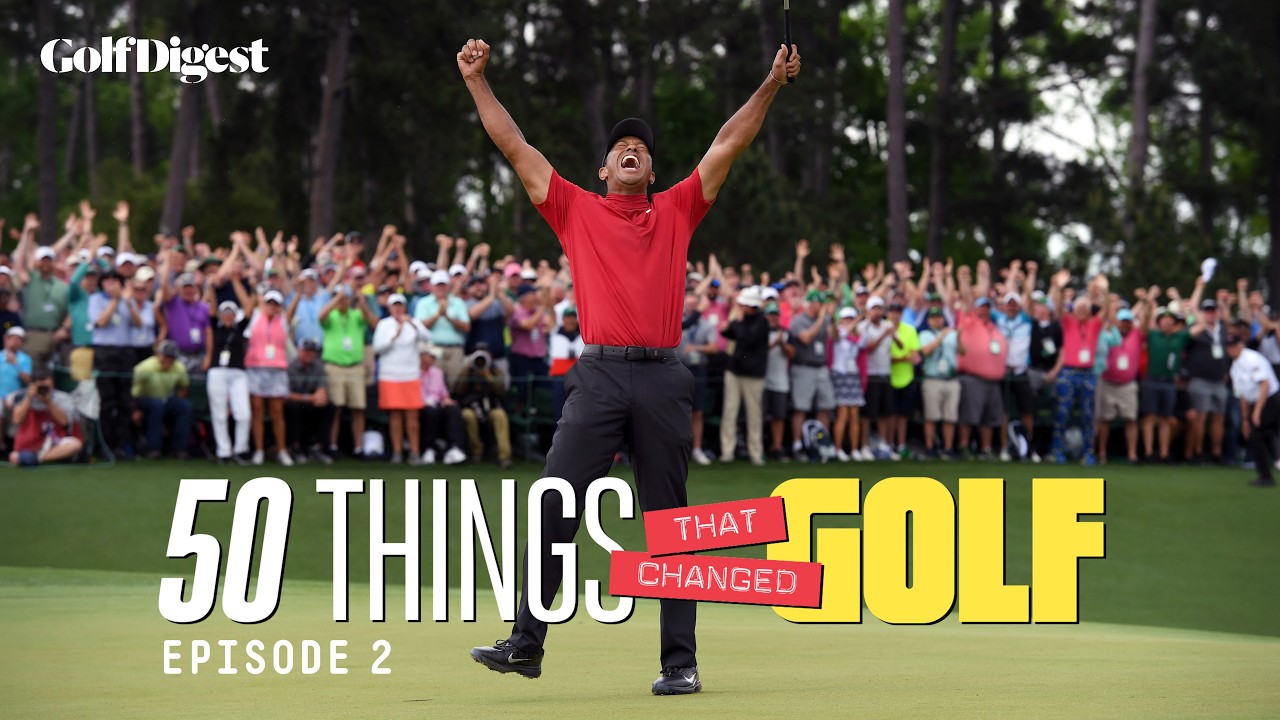
For Shane Ryan, the case for Tiger Woods' greatest major is not up for much debate. Asked to rank his favourite Tiger wins from the 14 majors before the 2019 Masters, the Golf Digest contributor picked the 2000 US Open at Pebble Beach first and did not apologise for the choice.
"I'm going to take number one, the 2000 US Open, Tiger Woods," Ryan said on Golf Digest's Episode 2 of its '50 Things That Changed Golf' series on the 2019 Masters. "This is kind of an obvious one. He blew everybody out at Pebble Beach. But what was so thrilling for me about this is first off, it's the beginning of the Tiger Slam and it's the most emphatic win he's had."
The numbers behind the selection still make the eye water. Woods won by 15 shots — the largest winning margin in a men's major championship — over Ernie Els and Miguel Ángel Jiménez. No other player in the field finished the week under par. The second round alone, a 69 in demanding conditions, effectively ended the tournament as a competitive contest. By Sunday, the question was not who would win; it was how far ahead Woods would finish.
Ryan's argument is built around two ideas. First, the margin. A 15-shot victory at a US Open, on one of the most demanding setups in golf, is not a scoreline that lends itself to qualifiers. It is the kind of performance that either gets described as "unrepeatable" or invites the viewer to accept that Woods, at that moment, was simply operating on a different plane.
Second, the context. The 2000 US Open was the launch point of what became known as the Tiger Slam — four consecutive major championships held simultaneously. Woods followed Pebble Beach with victories at the Open Championship at St Andrews (by eight shots), the PGA Championship at Valhalla (in a playoff over Bob May), and the 2001 Masters. No player in golf history has matched that feat. For Ryan, starting that sequence with the largest margin of victory in major history makes Pebble Beach the defining moment, not merely a component.
"It's the most emphatic win he's had," Ryan repeated, a phrase that is hard to argue with statistically. Woods' other signature majors — the 1997 Masters at 12 shots, the 2006 Open at Hoylake, the 2008 US Open on a broken leg, the 2019 Masters at 43 — each have their own case for personal significance. None matches the raw distance between Woods and the field at Pebble Beach.
The choice is also revealing of how golf historians increasingly frame Woods' career. For years, the conversation defaulted to the 1997 Masters as the moment Woods announced himself. Ryan's selection, made decades on, suggests that the 2000 US Open has displaced that narrative as the purest single expression of Woods at full power. The 1997 Masters was a breakthrough. Pebble Beach was a statement.
For viewers revisiting Woods' career through the lens of Golf Digest's retrospective, Ryan's case doubles as a useful reference point. Whatever new chapters unfold, the 2000 US Open remains the performance against which every other dominant major run has been measured.
And by that measure, as Ryan made plain, nothing has come close.